
- An offer wall is a menu of small tasks, surveys, app installs, sign-ups that pay you points or cash for completing them.
- Offerwalls are built by third-party ad networks and embedded inside reward apps; they are not run by the app itself.
- Reward amounts change constantly because advertisers set and adjust their own budgets in real time.
- Your location, device, demographic profile, and how far along in a task you are all affect what you get paid.
- US users generally have access to more offers and higher payouts than users in most other countries, but availability still varies by platform.
- Reading task requirements carefully before you start is the single most effective habit you can build.
What Exactly Is an Offerwall, in Plain English?
Imagine walking into a store and seeing a giant bulletin board covered in sticky notes. Each sticky note says: "Do this small thing, get this reward." Some notes ask you to download a game, some ask you to fill out a short survey, others want you to sign up for a free trial or reach a certain level in a mobile app. That bulletin board, inside a reward app on your phone, is an offerwall.
Definition
An offerwall is a collection of sponsored tasks placed inside a reward app or website. Each task is funded by an advertiser who wants users to engage with their product. When you complete a task, the advertiser pays the platform, and the platform shares a portion of that payment with you as points, coins, or cash.
The word "wall" is pretty literal: the interface typically shows you a long, scrollable list (or wall) of tasks all at once. You pick the ones that interest you, complete them on your own time, and collect your reward. Simple in theory, and once you understand the mechanics, it genuinely is that straightforward in practice.
One important distinction most beginners miss: the reward app you downloaded (say, a GPT, Get Paid To site or a cashback app) probably didn't build that offerwall itself. In most cases, offerwalls are developed by specialized ad-tech companies, firms like Tapjoy, Offertoro, Lootably, or AdGem, and the reward app simply embeds one or more of these networks inside its interface. That is why you will notice the same survey popping up on two completely different apps. You are seeing the same advertiser campaign served through the same offerwall provider.
How Does an Offerwall Actually Work — Step by Step?
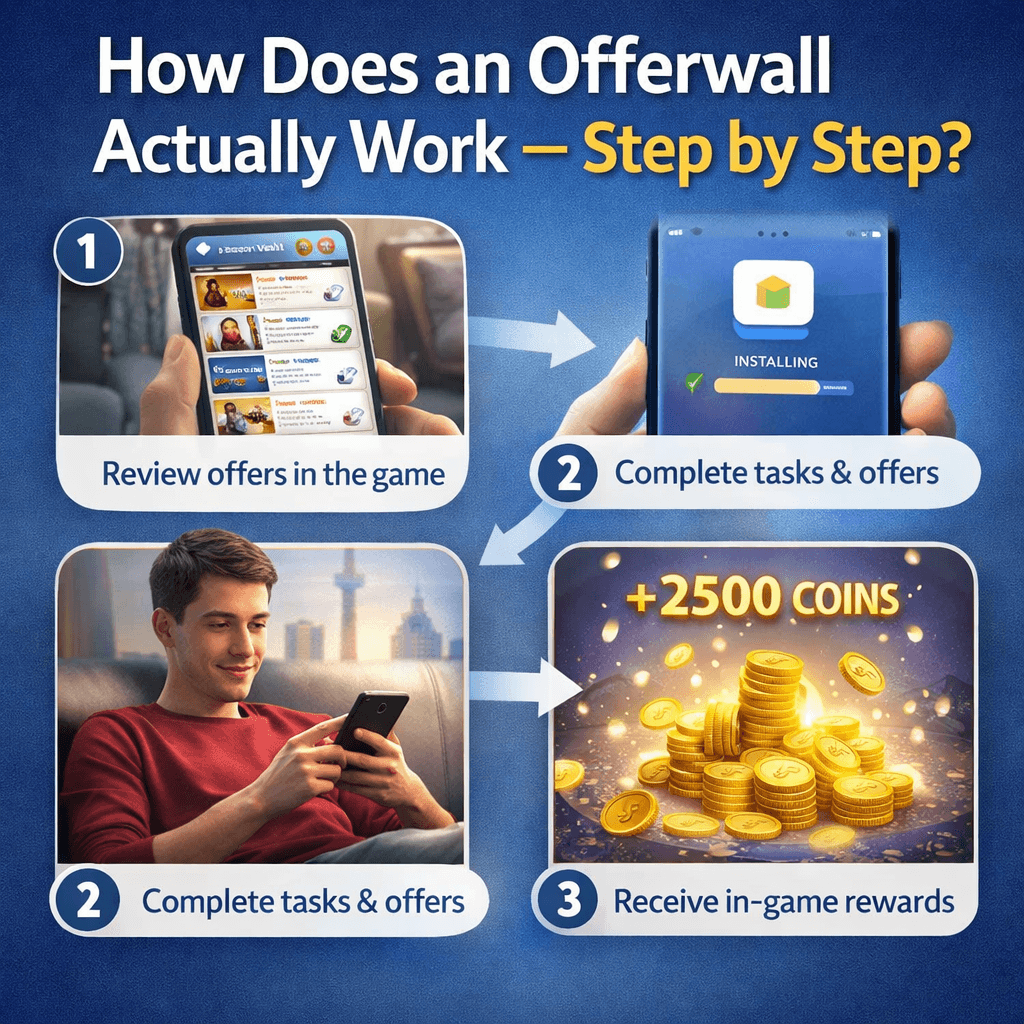
It helps to trace the journey of a single task from start to finish. Here is how the whole system moves:
- An advertiser creates a campaign: A mobile game company, subscription service, or brand wants new users. They go to an offerwall ad network and say: "We will pay X amount for every new person who installs our app and reaches level 5."
- The ad network places the offer on partner platforms: That task now appears across any reward app or GPT offerwall platform that has a deal with that ad network.
- You see the task in your app: You click on it, read what's required, and start the task, usually being redirected to an app store, a survey page, or an external website.
- You complete the required action: This is the step most people rush and regret. The advertiser tracks very specific checkpoints (more on this below).
- The advertiser confirms completion: Tracking is usually done through cookies, device IDs, or postback URLs. Once the advertiser's system registers that you hit the goal, it sends a signal back to the offerwall network.
- The reward is credited to your account.
Your app balance updates, sometimes instantly, sometimes after a manual review that can take a few days.
Common Mistake: Many beginners start a task, close the app to check something else, and then can't figure out why their reward never arrived. Always complete an offerwall task in a single session unless the instructions explicitly say otherwise. Switching apps mid-task can break the tracking link.
Why Do Offerwall Rewards Vary So Much?
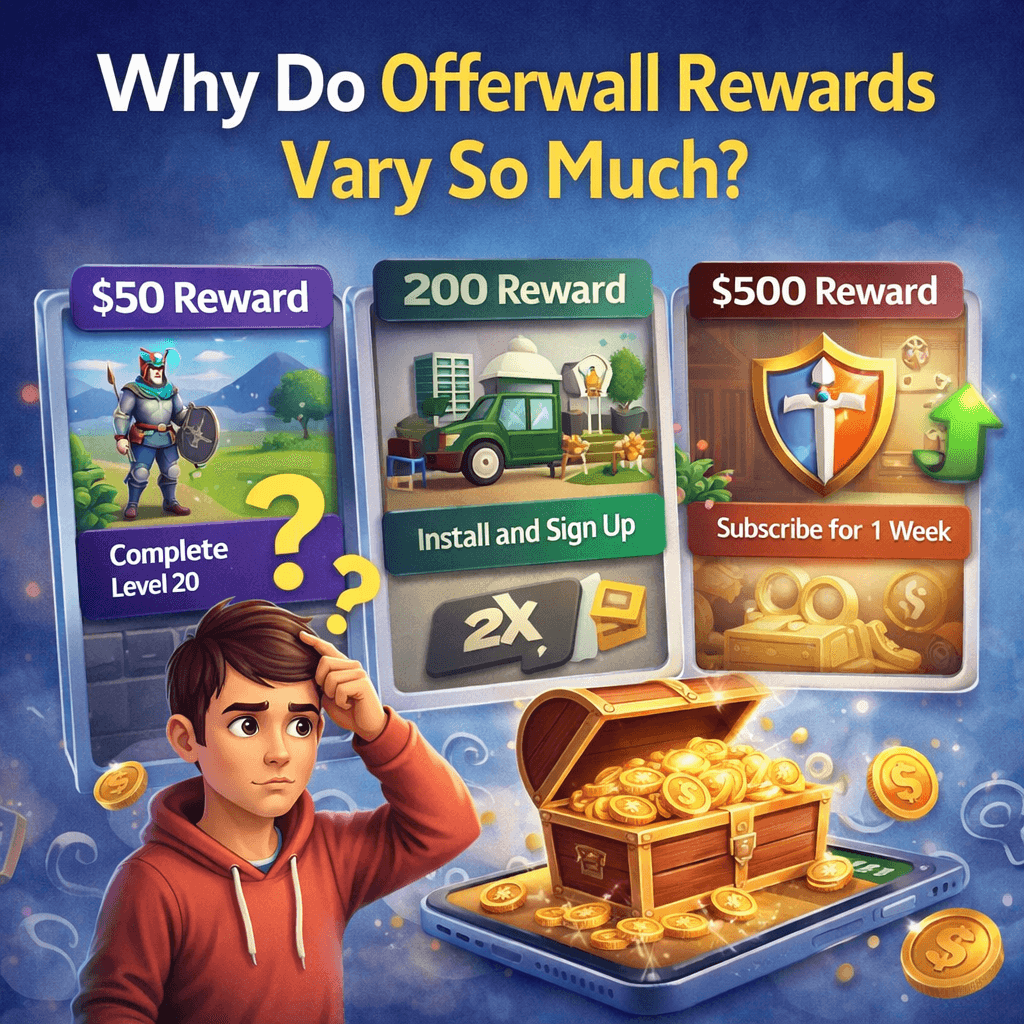
This is the question almost every new user asks within their first week. You do what feels like the same type of survey twice, and one pays three times more than the other. Or the same offer pays differently on two different apps. Here is the honest breakdown of what drives those differences.
Advertisers Control the Price — and They Change It
Every single task on an offerwall has a price set by the advertiser behind it. That price is not fixed. Advertisers can, and do, raise or lower payouts based on how many completions they have already received, how much budget they have left this month, or how well their campaign is performing. If a game already hit its user acquisition goal for the week, they might drop the payout or pull the offer entirely. If they need a last-minute push before a product launch, they might temporarily double it.
This means the reward you see today for installing an app might be 50% lower tomorrow through no fault of the platform you're using. The reward app itself has very little control over this.
Your Location Is a Major Variable
Advertisers allocate different budgets to different countries, sometimes different states within the US. A brand running a campaign only for New York residents won't show that offer to someone in rural Montana at all. For users in other parts of the world, the gap is even wider: reward apps available in the US tend to carry significantly higher-paying offers than the same apps in smaller advertising markets, simply because US consumers represent more advertising value to most brands.
If you are based in the US and using a major GPT offer wall platform, you will generally have access to more tasks and higher base rewards than users in smaller markets.
Then take advantage of that by checking new offers daily, since high-value US-targeted campaigns often have limited completion caps and disappear quickly.
If you notice an offer available on one app but not another, even though both apps use the same offer wall provider,
Then it is likely that the first app negotiated a different revenue share agreement, or the advertiser specifically targeted that app's user base.
Task Complexity and Advertiser Risk Drive Payout Size
A 2-minute survey that asks your opinion on a brand of cereal is low-stakes for the advertiser, they are paying for data, not a conversion. A task that requires you to sign up, verify your email, and make a purchase is high-stakes, the advertiser is paying for an actual customer, so the reward is much larger. Put simply: the harder or more committed the task, the more it tends to pay. That is not a rule with zero exceptions, but it is a reliable pattern to internalize.
Demographic Targeting Filters Your View
Survey offers reward apps in particular use screener questions at the start of almost every survey. If you don't match the demographic a brand is targeting, age bracket, household income, homeowner status, or parental status, you will either be screened out early or never see that survey at all. This is why two people using the exact same app in the same city can see entirely different offer lists. You're not being treated unfairly; you're just not the profile that particular advertiser paid to reach.
GPT Offerwall Platforms vs. Standalone Reward Apps: What's the Difference?
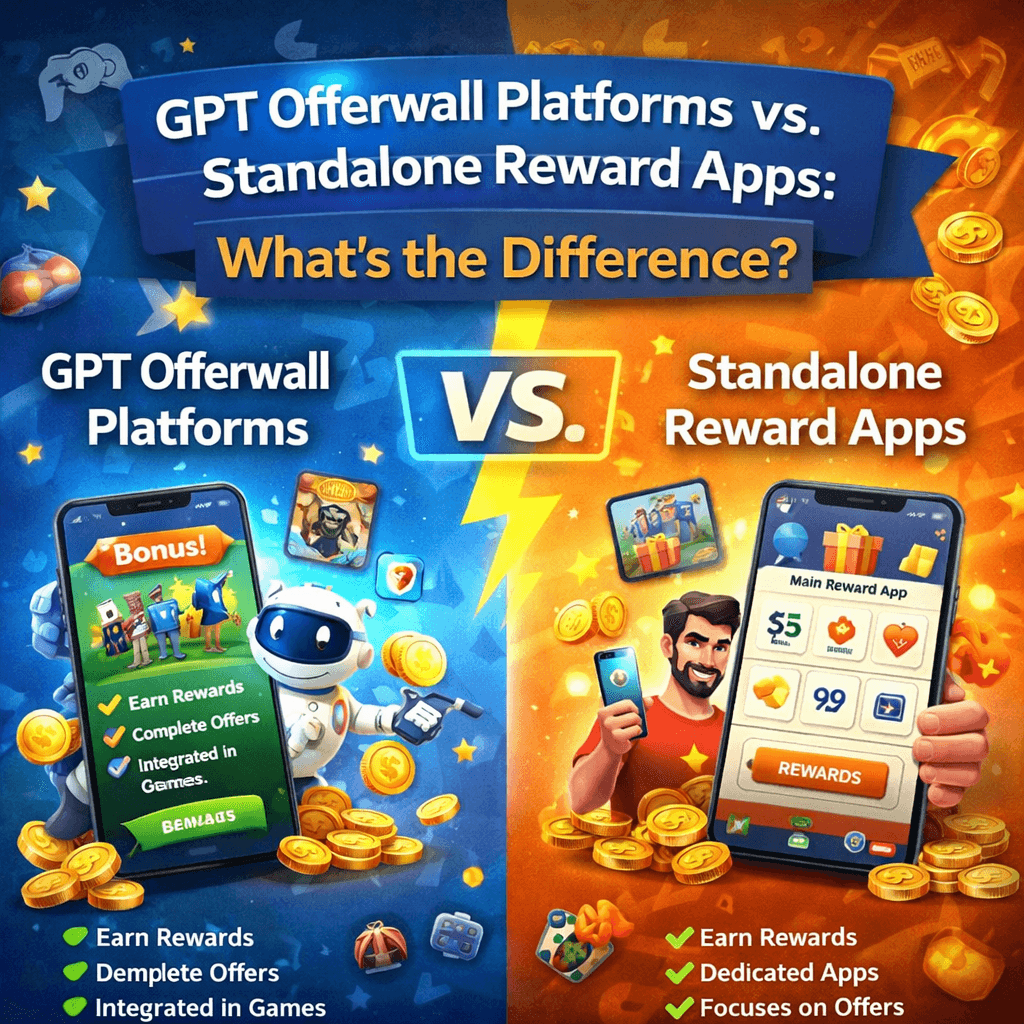
You will hear both terms used interchangeably online, but they describe slightly different things. Here's a clear comparison:
Platforms like CashDrill sit in this space by making it straightforward for US users to find and filter tasks, compare reward rates, and track their earnings without jumping between a dozen different apps.
What Types of Tasks Will You Actually Find on an Offerwall?
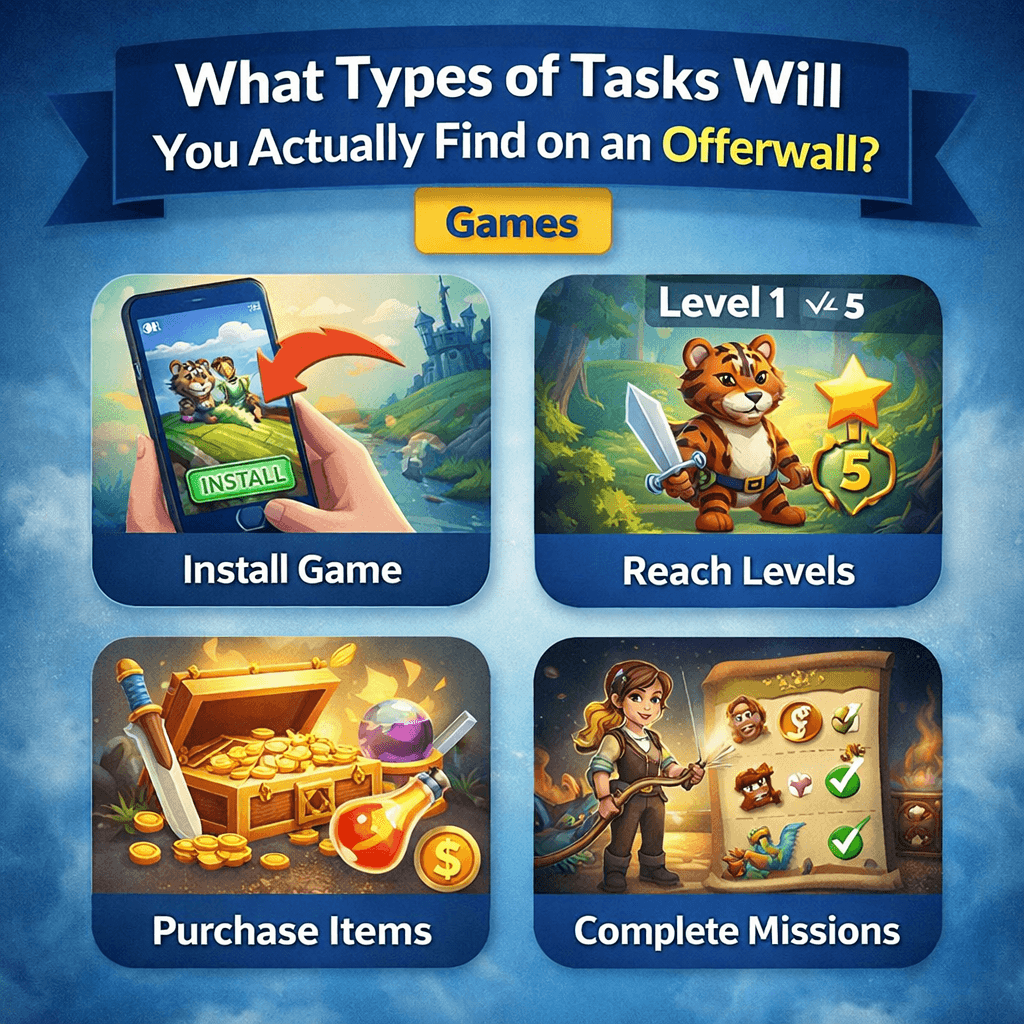
Knowing what's available helps you plan your time. Here are the most common task categories you'll encounter on reward app offerwalls:
- Online surveys: Opinion research from brands, market research firms, or academic institutions. Usually 5–25 minutes. Payout varies by length and screener match.
- App installs and in-app milestones: Download a game, reach a certain level, or make a purchase. Higher payouts but require more time and sometimes real money spent upfront.
- Free trials and sign-ups: Register for a service, sometimes requiring a credit card. Read the fine print carefully, some trials auto-charge if you forget to cancel.
- Video watching: Watch short ad videos, usually for small per-video rewards. Low effort, low payout, good for filling idle minutes.
- Shopping and cashback: Buy something through a tracked link and receive a percentage back. Only worth it if you planned to buy anyway.
- Quizzes and polls: Very quick, very low reward, but consistent and never disqualified mid-way.
💡 Pro Tip: App milestone tasks (like "reach level 20 in [game]") often offer the highest per-hour value on an offerwall, but only if you'd genuinely enjoy playing the game. If you treat it as forced work, you will likely quit before hitting the milestone and earn nothing. Choose tasks that align with things you already like doing.
Do/Don't: Habits That Separate Consistent Earners from Frustrated Beginners
How US Offerwall Rewards Work Compared to Other Markets
If you are in the United States, you are in one of the most advertiser-sought demographics on the planet. That translates to real, practical advantages when using offerwall apps in the USA:
- More active offers at any given time, US-focused campaigns are typically the largest and most frequent on any major offerwall network.
- Higher base CPAs (cost per action), Advertisers pay more per US conversion because the average US consumer's lifetime value is higher to them.
- More payment options, PayPal, Visa gift cards, Amazon credits, and direct bank transfers are all common payout routes for US users on major platforms.
- Faster new offer turnaround, New product launches, app releases, and subscription services tend to hit US offerwall campaigns first before rolling out internationally.
Final Words
Offerwalls are genuinely one of the more transparent ways to earn small rewards online, once you understand who's actually in control of what. The reward app isn't setting your payout. The advertiser is. The offerwall network is the middleman connecting the two. That chain of control explains almost every inconsistency you'll notice: why rewards change overnight, why you get screened out of surveys, and why your friend on a different platform earns a different amount for the same-looking task.
Understanding offerwall rewards explained at this level means you will stop feeling frustrated by the inconsistencies and start making smarter decisions about which tasks to prioritize and which to skip. Think of it as a skill, not a lottery. The more deliberately you choose your tasks, read requirements, and track what actually pays for your profile, the more consistent your results will be over time.
For anyone looking to build that habit, exploring a curated platform like CashDrill, which organizes reward opportunities specifically for US users, is a solid starting point. The goal isn't to replace a job; it's to get useful value out of spare time you'd spend on your phone anyway.