
- Reward apps use layered fraud detection systems that flag VPNs, proxy connections, and GPS spoofing almost instantly often before you earn anything.
- Getting caught doesn't just mean a failed task; it can mean a permanent account ban, forfeited earnings, and a blacklisted device ID.
- Platforms like Freecash use behavioral and network fingerprinting, meaning a Freecash VPN or fake GPS risk extends well beyond your IP address.
- Location data in reward apps is tied to advertiser compliance, not just user verification, faking it breaks the entire value chain.
- There are legitimate ways to boost app rewards without ever putting your account at risk.
- Terms of service violations, VPN, and GPS spoofing are treated as fraud — not minor infractions.
How Do Reward Apps Actually Make Money — and Why Location Matters So Much?
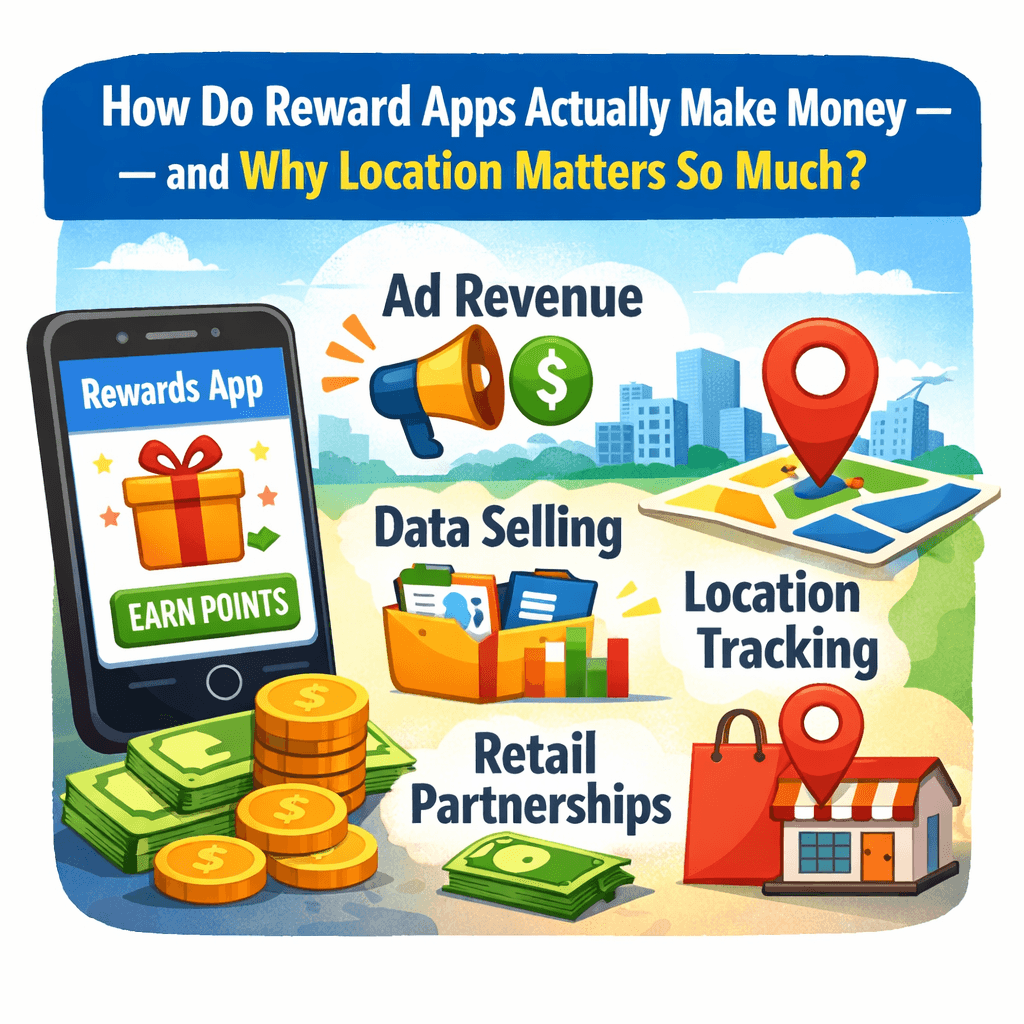
Before diving into the mechanics of detection, it helps to understand the business model behind reward apps.
Reward apps earn revenue by connecting advertisers with real users in specific markets. An advertiser in the United States will pay to show an offer only to users physically located in the US. A mobile game looking for new players in Germany will only pay for installs from German devices. This is not a technicality, it is the entire commercial foundation these platforms are built on.
When you complete an offer on a reward app, the platform sends a conversion signal back to the advertiser's tracking system. That signal includes device data, network information, and geolocation. If any of those signals look inconsistent, say, your IP resolves to a server in Amsterdam but your phone says you're in Texas, the advertiser's system flags it. The reward platform gets penalized. You get nothing.
Definition: Geolocation-based offer targeting is the practice of restricting reward tasks, surveys, and app installs to users in specific countries or regions, because advertisers only pay for activity from their target audience. This is why how geolocation affects reward redemption apps is not a small detail, it sits at the center of every transaction on platforms including CashDrill, Freecash, and similar earn-and-redeem services.
What Happens When Reward Apps Detect a VPN or Fake GPS?
The Detection Systems Are More Sophisticated Than Most Users Realize
Modern reward platforms do not rely on a single check. They use multiple simultaneous signals to verify that a user is who and where they claim to be. Understanding how reward apps detect VPN and GPS spoofing helps explain why these tricks fail so reliably.
Common detection signals include:
- IP reputation databases: VPN exit nodes and datacenter IPs are catalogued by fraud prevention services. A residential IP from Iowa looks very different from a server IP belonging to a commercial VPN provider.
- Device fingerprinting: Your device's hardware configuration, screen resolution, installed fonts, sensor data, and dozens of other attributes create a unique fingerprint that persists even if your IP changes.
- GPS vs. network triangulation mismatch: Phones can be located using cell tower and Wi-Fi data independently of GPS. If your spoofed GPS says you're in New York but your Wi-Fi is pinging towers in Southeast Asia, that discrepancy is logged.
- Behavioral analysis: Completing offers faster than humanly possible, switching between regions in unrealistic timeframes, or claiming offers that aren't available in your stated location are all behavioral red flags.
- Accelerometer and sensor data: GPS spoofing apps frequently trigger anomalies in sensor readings because a moving, human-operated phone has natural micro-vibrations. A perfectly still, spoofed location does not.
⚠️ Warning: Even if a reward app doesn't immediately flag your account, it may silently shadow-flag it. This means your tasks appear to complete normally, but your earnings are held, reviewed, and eventually forfeited when the account is formally reviewed. This is one of the most costly common mistakes users make with reward apps, assuming silence means safety.
What Are the Real Penalties for Using Fake GPS in Reward Apps?
The consequences of mobile app fraud detection reward apps catching you range from inconvenient to severe. The penalties for using fake GPS in reward apps are tiered but escalate quickly:
Because these platforms work with advertiser networks, a single fraudulent user can trigger a broader audit. Some platforms share fraud data across their network, meaning a ban on one app can affect your eligibility on partner platforms entirely.
If/then statement: If your account is permanently banned for terms of service violations VPN and GPS spoofing, then creating a new account on the same device, or even the same network, will often result in an automatic ban on the new account as well.
Do Reward Apps Actually Ban Accounts for VPN Use?
Yes, and the enforcement has become significantly more aggressive as advertiser expectations have increased.
The question of do reward apps ban accounts for VPN use has a straightforward answer: they do, consistently, and the bans are usually permanent. Platforms like Freecash explicitly state in their terms of service that using tools to manipulate location data or bypass regional restrictions is prohibited. The Freecash VPN or fake GPS risk is real: the platform's fraud systems are actively maintained and updated regularly. Using a VPN to access region-locked offers, or spoofing your location to appear in a higher-paying market, falls squarely under the prohibited activity covered in any rewards app user policy VPN location clause.
📋 Key Rule: Most reward app Terms of Service include a clause that allows the platform to forfeit any and all pending or unpaid earnings if fraud is detected, regardless of how long you've been a user or how much you've legitimately earned.
Common mistakes users make with reward apps often stem from a misunderstanding of what "location" actually means in this context. It is not just about where you physically are. It is about ensuring every data signal, IP, GPS, device language, app store region, and payment method, aligns consistently. A mismatch anywhere in that chain raises flags.
Why Cheating Location Doesn't Work on Reward Apps: The Advertiser Side
Here is a perspective that rarely gets discussed: why cheating location doesn't work on reward apps is partly because the advertiser, not just the reward platform, is independently validating the conversion.
When you install an app through a reward platform's offer wall, that install is tracked by the advertiser using a mobile measurement partner (MMP) like AppsFlyer, Adjust, or Singular. These third-party tools perform their own fraud verification independently of the reward app. They check:
- Whether the install originated from a real device.
- Whether the IP matches the expected market.
- Whether the install pattern matches organic user behavior.
- Whether the device has been flagged in fraud databases.
If the MMP rejects the conversion, the reward platform doesn't get paid. If the reward platform doesn't get paid, you don't get paid, and your account gets flagged for submitting fraudulent conversions.
This is also why apps that don't require real location to earn exist in such limited numbers. Most legitimate offers are tied to advertiser markets, and there is no way around that without the platform losing revenue on every flagged transaction.
What About Users Who Just Want Privacy — Can't They Use a VPN?
This is a fair question, and the answer requires nuance.
Using a VPN purely for privacy, not to spoof your location or access region-locked offers, is still risky on most reward platforms. Even a privacy-focused VPN routes your traffic through an IP that is flagged in commercial fraud databases. The platform's system doesn't know your intent; it only sees a non-residential IP address.
Do/Don't List for Reward App Safety and Compliance:
These guidelines apply directly to reward app safety and compliance on any platform. They are not arbitrary restrictions, they exist because every violation costs both the platform and the advertiser real money.
Legitimate Ways to Boost App Rewards Without Breaking the Rules
The good news is that there are real, sustainable strategies for earning more, and none of them require violating platform policies. These legitimate ways to boost app rewards compound over time and build a stronger account standing.
How to Maximize Earnings the Right Way
1. Focus on high-value offer categories. App installs and game progression offers typically pay more than surveys. Learn which categories your region offers the most of and prioritize accordingly.
2. Read offer requirements completely. Many users miss out on credits because they don't hit the specific milestone required, like reaching level 20 in a game, not just downloading it. This is one of the most frequent common mistakes users make with reward apps.
3. Use referral programs. Most platforms have referral systems that pay ongoing bonuses when people you invite complete offers. This is one of the highest-return activities available to any user.
4. Complete daily tasks and bonuses consistently. Reward apps often have streak bonuses or daily login rewards that compound over time. These are small individually but meaningful over weeks.
5. Keep your profile complete and verified. Fully verified accounts often get access to higher-paying surveys and exclusive offer walls because advertisers prefer verified demographic data.
6. Engage during promotional periods. Platforms run double-point events and limited-time offer bonuses. Setting a reminder to check the app during these windows pays off consistently.